
A little listening. A little discovering.
Beginning sounds
worksheets.
Choose familiar sounds. Make a picture worksheet.
Print it, and try it together.
A peek at your page.
b · c · f · m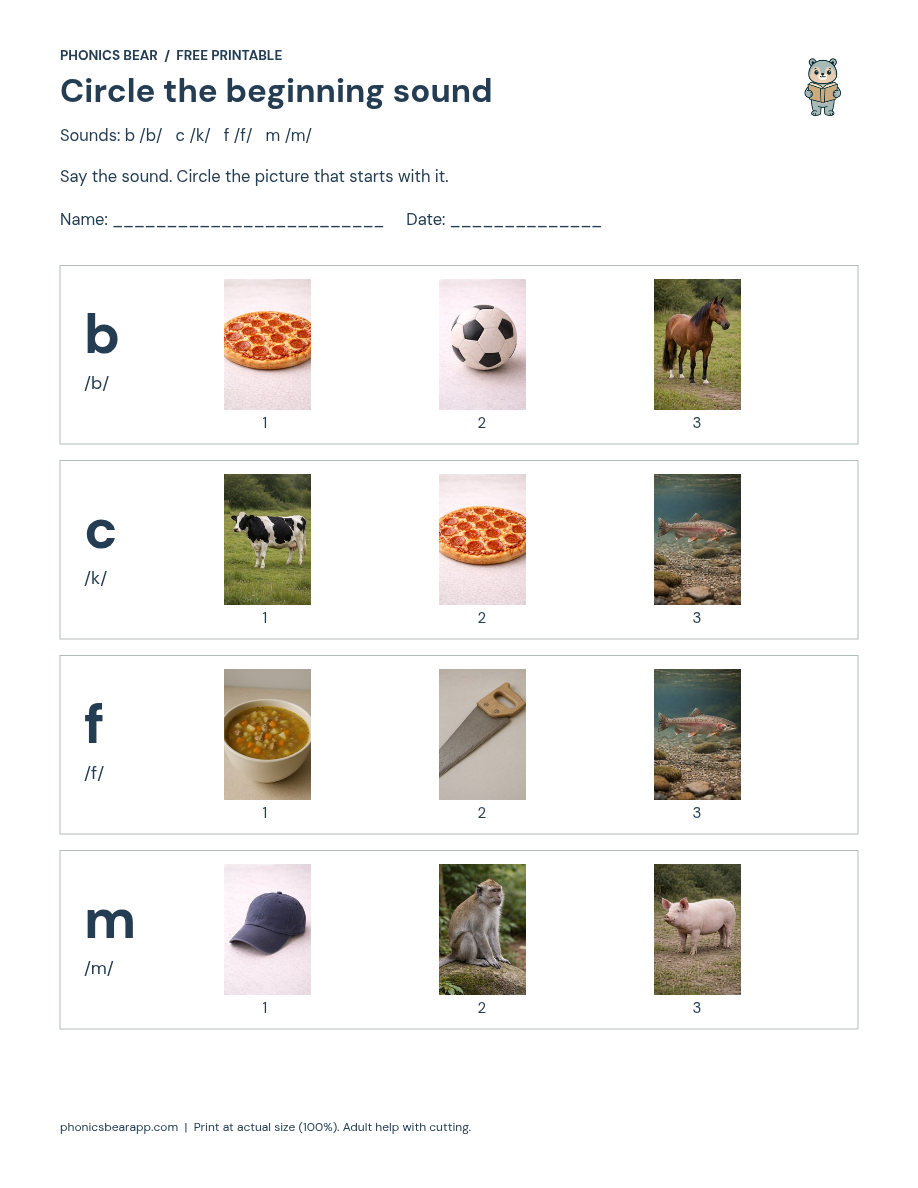
Print at actual size (100%), single-sided. The adult key is on a separate page; leave it out for children.

Ready when you are
Skip the setup. Start with a pack.
Three worksheets for b, c (/k/), f and m: circle, match, and cut-and-sort. Three adult keys with picture names. Original color pictures, generous margins, no signup.
How to use these initial sounds worksheets
- Name the pictures first. Use the intended words on the adult key: say “ball,” for example, rather than “soccer ball,” and use “hat” for the cap picture. Children do not need to read the picture names.
- Listen to the first sound. For ball, listen for /b/. Say the sound rather than just the letter name. Choose sounds your child is already exploring.
- Try one format together. Circle one picture per row; use each letter once in matching; or cut the cards and place two in each sound box. An adult should handle or supervise scissors.
If a picture is unfamiliar or your family uses a different word for it, name it together using the key, or skip it. These are suggested practice activities, not a reading assessment or a mastery test. No score or child information is collected by the maker.
What’s in the picture set?
The eight beginning-sound groups are b, c as /k/, d, f, h, m, p and s. Each uses two pictures from the Phonics Bear app: ball/bee, cup/cow, dog/door, fish/fork, hat/horse, monkey/mug, pig/pizza, and saw/soup. We have left out long/short vowels, digraphs and misleading examples such as xylophone for x. The sound /sh/ in ship is not the /s/ sound.
Do I need an account or an app?
No. Download the ready-made packs directly or create a PDF in your browser. Your choices stay in this page; no account, child name or upload is needed. Ordinary website analytics are described in our privacy policy. The PDFs leave a blank name line you can fill in on paper.
What comes after beginning sounds?
Recognising the first sound is one practice task. It does not by itself show that a child can blend or read words. When you want to explore bringing sounds together, try our blending guide or CVC word list and printable. Keep practice aligned with what your child’s teacher is introducing.
The broader sound–letter principle is supported by Recommendation 2 of the IES foundational reading guide. These specific worksheets are Phonics Bear’s suggested activities, not an IES-prescribed sequence or independently evaluated programme.
One more way to explore sounds.
Looking for practice on iPhone? See Phonics Bear’s free flashcards and optional Gold access after you have your printable.
View Phonics Bear